The most widespread view of Julius Caesar’s calendar reform is that after 45BC, the leap years were misapplied, namely every 3rd year instead of every 4th. Brutus assassinated Caesar in March of 44BC, so this seems believable.
This is the so-called fencepost error; see the image above. For a 10m long fence, 11 posts are needed, not 10. It is today a typical “software cycle bug” in programming. Some explain the leap year error as an “inclusive count” mistake of the leap year cycle. This is hardly plausible, as it would suggest that they may have been counting in the current “exclusive way” when the leap year cycle of the new calendar was set and promulgated.
The leaping failure lasted rather long, 36 years. Instead of nine, 12 leap years were added. Emperor Augustus had to restore the calendar after 9BC, omitting three leap years. Because emperor Augustus restored the calendar, it only started to function correctly (according to the original plan) again from AD8. Some calendar experts calculate that the restoration was finished already in AD4.
The above erroneous use of leap years is described by only one early reference and one later recollection (Solinus, 3rd century AD and Macrobius, 5th century AD). However, at least nine conflicting theories explain the misuse of leap years, and the different recalculations show unreliable results.
According to recent research on the other side, it is known that in Alexandria, the correct roman calendar leaping was applied during these years. Emperor Augustus seems to change the old civil calendar in Alexandria according to the 4-year leap-year cycle of the Julian calendar as early as 24BC.
In my opinion, if Augustus knew already in 24BC that the Roman 3-year leap year application was wrong, he would not have waited until 9BC to start correcting the error in Rome. (Even though that year he was not yet the “lord of time”, Augustus was Pontifex Maximus only from 12BC). And if in 24BC he had not yet known that the leap year was wrong, he would have introduced the bad leap year of 3 years in Alexandria, too.
The correct decreed and applied Roman leap year in Egypt may suggest that Rome’s calendar was not corrupted for 36 years. As far as I see, the later historical recollection of the misunderstanding and misuse of leap years may be wrong.
On the other side, it also appears that the Gregorian Dilemma would have meant six days instead of 3 if there had indeed been a leap year error, but Emperor Augustus would not have restored it.
For a long time, many calendar scholars assumed that Pope Gregory XIII had to delete ten days because the First Council of Nicaea (325 AD) had already removed three days from the Julian calendar earlier. The omission of 3 days by the First Council of Nicaea is now rejected by most scholars because there is no evidence. There are no sources of skipped days or changing the order of leap years either in the year of the First Council of Nicaea or in the decades followed. However, the final solution to this dilemma has been missing until now.
All the sources I know claim that Emperor Augustus has fully restored the Julian calendar, considering all the days passed. So, as a total of inserted and cancelled leap years of the Julian calendar, no days were added or deleted before AD8. Consequently, how leap years were applied up to AD8 is only relevant if we look for a specific date between 45BC and AD8.
The significant point for the following is that between AD8 to AD1582 (from finishing the restoration by Augustus until the calendar reform of Pope Gregory XIII), the Julian calendar functioned continuously and unchanged as planned initially by Caesar and Sosigenes. (Whether or not the leap year error and the restoration took place.)
We come back to the leap year issue in a later post concerning the birthday of Emperor Augustus.
Since the lunar month is approximately 29.5 days long, the oldest version of the early Roman lunar calendar, which dates to before the state’s founding, probably had months of 29-30 days, alternating.
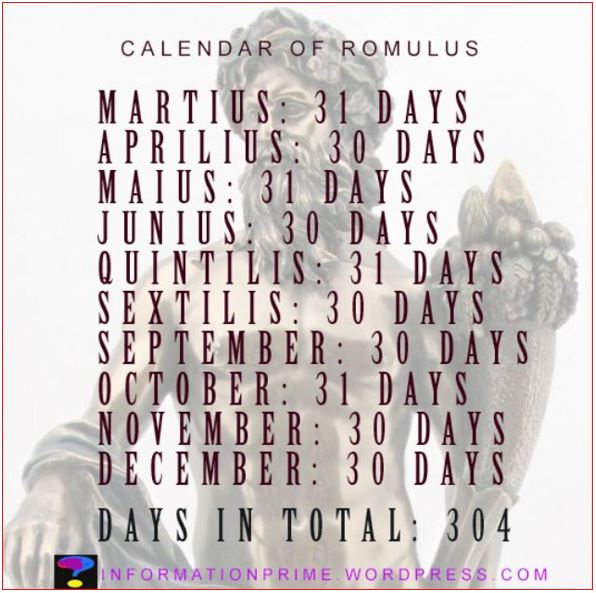
Over the centuries before Caesar’s reign, the old Roman lunar calendar underwent several profound transformations. Already Romulus or Numa Pompilius had increased the length of the months. The year began with March, and only ten months were given names or numbers. This lunar calendar of 304 days was created, with four named months (Martius, Aprilis, Maius, Iunius) and six numbered ones (5th-Quintilis; 6th-Sextilis; 7th-September; 8th-October; 9th-November and 10th-December). However, these ten months did not make up a solar year, so a two-month anonymous period was inserted into the period of winter inactivity.
Later, the onset of winter got the names Ianuarius and Februarius; the calendar had 12 months. The calendar year would have been only 354 days long in standard years, but it was extended to 355 days because of superstition. For this purpose, the length of the months was changed. Four months of 31 days, seven months of 29 days and February of 28 days resulted in a 355-day year. The structure of the Republican 355-day calendar is presented in the next chapter.
Meanwhile, in 153 BC, the first day of the year was moved to 1 January, when the new officials took office.
This would not have been sufficient for the revamped calendar to build a solar year. Therefore, 22 or 23 “leap days” (intercalation) were alternately inserted between 23 and 24 February every two years. Formally changed the length of February (including the intercalary months if needed) according to the sequence: 28 days or 50 days, and 28 days or 51 days.
The duration of the four-year cycle was thus 355+377+355+378 = 1465 days.
However, this made the years about one day too long; on average, 1465/4 = 366.25 days.
The astronomical phenomena, e.g., the vernal and autumnal equinoxes, continued to “jump” in the calendar. Their dates also “slipped” backward in the calendar by an average of 1 day per year.
The situation was aggravated because the priests who kept the calendar did not follow the calendar rules. The 22 or 23 extra days (intercalation) prescribed every two years were applied irregularly.
The Roman calendar was “destroyed” so much that Caesar had to add 67 extra days to the year 46 BC (in addition to the required 23 days). As a result, the “last year of confusion” (Ultimusannus confusionis) was 445 days.
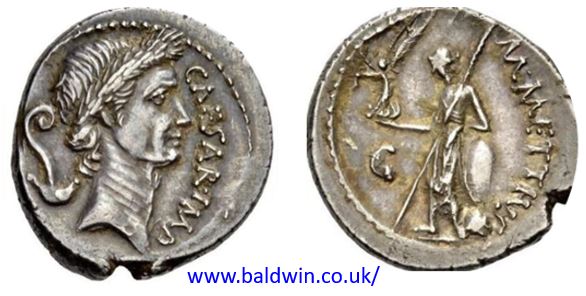
Gaius Julius Caesar’s (100BC – 44BC) calendar reform began only 45 years before AD1. It is worth analysing the circumstances of Caesar’s calendar reform because the new calendar was based on precise astronomical principles and has stood the test of time.
The historians and calendar experts agree that Julius Caesar introduced the new solar Julian calendar on 1 January 45BC.
Caesar was not only the dictator of the Roman Republic.
He was also Pontifex Maximus, the chief high priest officer of the Roman priesthood, so he was the Lord of Time in the empire.
Caesar’s new calendar was based on the Egyptian model and was developed on the knowledge and suggestions of the ancient Greek astronomer Sosigenes of Alexandria.
At the time of Caesar’s calendar reform, the Egyptian civil calendar had already been a solar calendar with a year length of 365 days for a very long time (2300 years, according to the majority opinion, since Pepi II; VI dynasty; according to other views about 5000 years).
In the solar civil calendar year, there were 12 months, equally 30 days long and an additional short period, 12*30+5=365 days. For example, in this calendar, the date of the vernal equinox VEQ or any other astronomical date was advanced by one day every four years until it circled the whole year.
However, the calendar of the Egyptian priest-astronomers contained 360+5 days three years long and 360+6 days in the fourth year. After 1461 civil years and 1460 priestly years (Sothis cycle, a total of 533265 days), the two Egyptian calendars “converged”, and this “meeting” was celebrated with a large public festival.
The priestly calendar was astronomically much more accurate than the civil calendar and served as a model for Caesar’s Julian calendar.
In the new Julian calendar of Caesar, the length of the standard years (365 days) and the length of the leap years (366 days) were controlled by the “size” of the month February, like today.
Accordingly, the old Egyptian priestly calendar and the new Julian calendar were equally accurate, with an average year length of 365.25 days.
Because of their simple, predictable, reliable, and fixed nature, the Egyptian and Julian calendars (except for the first 52 years of the Julian calendar, the period of uncertain leap years, see below) are easily convertible. The Julian and Egyptian calendars can be formally well synchronised even into the centuries before 45 BC. The Julian calendar allows dates to be accurately calculated back (retrospective feature), even centuries before Caesar’s time. This also applies to forward-looking (prospective) calculations into the future.
Centuries after the Julian calendar was introduced, it did not yet have a calendar year in the modern sense of AD years.
When we hear or read “Easter table” today, we usually think of something like on the photo left. A beautifully set holiday table decorated with eggs, flowers, and bunny figurines.
But we have also inherited another interpretation from ancient times. The old term “Easter table” also has essential religious, scientific, and astronomical meanings.
In this post, we review the history of the Easter tables, which were essential in developing the AD system. We also examine the Easter tables’ supposed role in the assumed “misalignment of the AD time“.
Look at an old Easter table below; it looks like an ancient calendar!
Like its Jewish predecessor, Passover, Easter is a rotating, moving holiday whose date changes from year to year depending on the relationship between the day of the vernal equinox (VEQ) and the date of the full moon.
To simplify, the first day of Easter is the first Sunday after the first full moon following the vernal equinox VEQ.
The Easter table is a timetable that astronomically summarises decades in advance on which day Easter will fall in the future. The Christian Church has proclaimed Easter every year according to the Easter table in force at that time.
Each line of an Easter table corresponds to one year.
The method (algorithm) to calculate the day of Easter (computus paschalis, or computus for short), which is connected to the AD time and so to the current hypothesis, was developed initially by Egyptian Christian priest-astronomers.
The authors and constructors of the Easter tables essential for our topic are the followings:
St. Cyril of Alexandria (ca. AD376 – AD444)
Dionysius Exiguus (ca. AD470 – ca. AD544)
St. Bede the Venerable (ca. AD672 – AD735)
The AD years given above are retroactively calculated years. Earlier, other year-identifications were given without using the AD system that did not yet exist.
Alexandrian Easter tables existed before the Cyrillic period, too. Other Easter tables with slightly different algorithms were also constructed in the above time; however, they did not become significant in our AD time reckoning.
Today we are convinced that Bishop Cyril and the monks Exiguus and Bede were living historical individuals, and their successive, closely linked, “chain-like” Easter tables are genuine and relevant.
The period covered by these Easter tables is usually a multiple of the 19-year Metonic cycle. (see Explanations)
Easter Table of St. Cyril of Alexandria
Cyril continued earlier traditions invented by Anatolius of Alexandria to calculate the Date of Easter.
Ágoston Teres writes in “The Bible and Astronomy “:
“Bishop Cyril began his first cycle with the 153rd year of Diocletian and ended the last with the 247th year of the same tyrant.”
This corresponds to the Easter table period of AD437 – AD531.
The fall of the Western Roman Empire in AD476 happened during this period.
At this ancient time, counting was “inclusive”: between AD437 and AD531 elapsed not 94 but 95 years, as counting included the first and the last year. The inclusive counting (including) is unusual for us, but it is correct; it is only a matter of opinion.
For Bishop Cyril, the idea of a new time reckoning, introducing the serial numbers of the years starting with the year of Jesus’ birth or any other old Christian year, was outside his mind.
The last line of his Easter table was marked Anno Diocletian 247. Surprisingly, this marking was also abbreviated AD. (We use later for this ADio, see Abbreviations)
It is also strange that Cyril calculated many years back (starting from Diocletian) when this was not yet common.
And it is totally incomprehensible and unbelievable to me that the Christian Church dated anything concerning Diocletian, the great persecutor of Christians.
Easter Table of Dionysius Exiguus
Exiguus continued Cyril’s Easter table for the next period, AD532 – AD626, for the next 95 years, counted by the inclusive method. In the first 7 rows of his own Easter table (the rows corresponding to the years AD525-AD531, which are a repetition of the last 7 rows of Cyril’s table), he refers to the Diocletian years in the old way, like Cyril.
Exiguus introduced a new marking. He marked the first line of his own table instead of Anno Diocletian 248 (ADio248), rather.
"532 years of our Lord Jesus Christ"
“ANNI DOMINI NOSTRI JESU CHRISTI DXXXII”
but only to reidentify the row of his new table.
This was a synchronization of the AD date of Christianity with the years of the Roman era from the beginning of Diocletian’s reign, albeit unintentional.
It was unintentional because Exiguus did not want to introduce a new time reckoning either. He was merely trying to calculate the years between his own year of calculation and the year of Jesus’ birth for a different reason! For Exiguus considered it unworthy to continue to number the lines of his own Easter table with the years beginning with the first year of the reign of Diocletian, who was considered a cruel persecutor of Christians. So, he switched to marking the lines of his table with the year of Jesus’ birth. We know this from his letter to Bishop Petronius.
I find it curious that a letter from a simple monk from the 6th century has “survived”. Perhaps it survived because the Roman Church attached great importance to the calculation of Exiguus, the year of Jesus’ birth? In that case, how is it possible that Exiguus’ significant result was used exclusively as the serial numbers of the rows of Easter tables for the next two hundred years?
Furthermore, it is difficult for me to accept that Exiguus, living in Rome in AD525, counted according to a “computus” of Alexandrian origin, adopted it and carried it forward. I doubt this because shortly before, in AD451, the Roman Christian Church and the Orthodox Christian Church of Alexandria had broken off all contact for the next 1000 (one thousand!) years, mainly because of religious disputes, as far as we know today!
Let us remember my note in the earlier post “Jesus’ lifetime”:
“Exiguus performed the calculation back to AD1 precisely 7 years earlier (AD525 instead of AD 532) than would have been necessary for practice, even though the count could be done at most in a few weeks. And he made 7 years of error.
The double difference of 7 years seems to be a “strange coincidence”.
Indeed, it is more than strange to me. This coincidence raises the suspicion that Exiguus actually did not make his calculations in AD525, but only 7 years later, in AD532. In other words, he was correct in his first calculation concerning the year distance between his year and Jesus’ birth year, and he backdated later the correct result by 7 years for some mysterious reason. So, he moved the year of Jesus’ birth forward 7 years from 7BC to AD1.
Returning to the calculation of Exiguus:
We do not know exactly Exiguus’ calculation method; he probably compared several lines of thought. Exiguus based his calculation neither on AUC754 nor on the 195th ancient Greek Olympic Games (both were retroactively assigned to AD525). It seems that Exiguus controlled his measures based on the indiction cycles.
More than half a millennium earlier, Julius Caesar introduced the concept and application of the indiction cycle, following the Egyptian example. Indiction-cycles (tax cycles) spanned 15 years. The duration of military service was also 15 years, and taxes were the source of the maintenance of the army.
Unfortunately, the serial number of indiction cycles was not recorded, so the back-calculation based on indiction was rather complicated and unreliable. It should also be noted that in antiquity, it was not only the use of zero (as a number), but subtraction was unknown, too. Instead of subtraction, an addition was used, as did Exiguus like below:
Exiguus concluded that Jesus was born in the 4th year of the 4th indiction cycle, which he called the first indiction cycle. Furthermore, relative to this first cycle, the year of the calculation made by Exiguus was the 3rd indiction of his 36th indiction cycle.
By the 4th year of the first indiction cycle, 3 of the 15 years had elapsed. So, there were 12 years left up to 15 (to be added instead of subtracted 3). Of these 12 years, the first year was a fraction of a year of Jesus’ life, but according to the inclusive convention, this was counted as a full year, making up 12 years.
Thereafter, 34 complete indiction-cycles elapsed, so 34*15 = 510 years.
Exiguus’ own year was the 3rd year of his current cycle, and this was also a fraction of a year since the year Jesus was born to consider. Including calculated, Exiguus also took this year as an entire year, which means 3 years to add.
Hence, the result of Exiguus’ indiction calculation is as follows:
12 + 34*15 + 3 = 525; (including the year of Jesus’ birth and the year of his calculation). Furthermore, 525 + 7 = 532, because Exiguus did his calculation 7 years in advance.
The “Great Easter Cycle” of St Bede the Venerable
Bede continued the Easter table of Exiguus some 200 years later. He referred to Exiguus several times as Venerable Dionysius in his writings.
Bede incorporated Exiguus’ Easter table into his own table and then extended it up to AD1063.
The period of the first part of Bede’s Easter table was a repetition of Exiguus’ table. Thus, it spanned the period AD532 – AD626. The second table period, spanning 95 years, too, covered the years AD627 – AD721. The third covered AD722 to AD816, and so on up to AD1063.
The Easter tables of Bede span the duration of precisely one so-called “Great Easter Cycle”, i.e., including 28*19 = 532 years; 1063-532+1= 532. Moreover, in his own tables, Bede even calculated the date of Easter for the year AD1064, the 1st year of the next Great Easter Cycle.
Bede put into practice his idea that the years since the birth of Jesus and the AD notation could be used for “long-distance retrospective and prospective time reckoning”. This was obviously an excellent idea for the Christian church and religion. By spreading AD dating, the very act of saying or writing the year would have reminded believers of Jesus! But for a long time, almost nothing happened!
It is very controversial that although Bede had calculated 300 years ahead, the spread of AD time reckoning took about 300 years!It is possible that the progress of spreading was so slow because one wanted to cover something up.
The Connection between the Easter Tables and the AD Time.
As mentioned, each row of the Easter tables corresponds to a year, so these tables are, in fact, “simple calendars of year counting, year numbering”.
According to István Hahn, a Hungarian historian and member of the Hungarian Academy, in his work “Calendar systems and time reckoning “: “From the 11th century onwards, the calendar of the birth of Christ was the only calendar used in most of Europe.” (The book exists only in Hungarian. The blogger translated the title and citation.)
So, the Easter tables above begin in the Roman era and end in the period when our present-day AD time was already widespread! (Roman era: see Explanations)
Since the year of Jesus’ birth is linked to the Roman era, it can be said that there is a single continuous period of over a thousand years (including the 283 years before Diocletian) in history.
It can be stated that the Christian Church has recorded the year of Jesus’ birth at least since St. Cyril. The year of Jesus’ birth was (at least indirectly, in the form of identifying the lines of the Easter tables concerning Roman history back to Diocletian) well known.
To sum up, even the very continuity of the Easter tablesvirtually does not allow the insertion of a 220-yearerainto the timeline of history!
However, it is also noticeable that Bede retroactively repeated the Easter table of Exiguus. Then from AD627 onwards, i.e., before his own time, he produced a further retrospective Easter table. But any retrospective Easter table is meaningless and unnecessary because it has no practical application. The question arises: In the 95 years after the end of Exiguus’ table, was the date of Easter calculated annually? Someone else should make an Easter table between the time of Exiguus and the time of Bede. Why would there have been a need for Bede’s retrospective Easter tables?
We have already seen that the period from 476 to 725 AD could theoretically be appropriate for the insertion of a Phantom Time.
The retroactively compiled and retrospective Easter tables of Bede fall into this possible period.One might wonder whether Bede’s retrospective Easter tables were not made as “a virtual calendar of year counting” to bridge a historical time gap, to hide a phantom historical time.
We will see later that the subsequent falsifiability of the Easter tablets was made possible precisely by an ecclesiastical decision that influenced the computus.
We have mentioned that many medieval documents were proven to have been forgeries made retroactively.
Why should it not have been possible that the Easter tables of Bede were also forged?
This post briefly analyses why it is theoretically possible to insert a long period into history and shows how to interpret the effects of the insertion of an extended period.
We examine when was it possible to insert many years and how long the inserted period can be. Connecting, we also outline some “ideas” that can be used to implement the insertion of never happened historical events.
Historians have determined the annual time-distance and dates of the most basic ancient historical events by astronomical “countdown”, back-calculation. That is, by retroactive calculations back to the dates of an astronomical phenomenon that occurred at the same time as the event in question and was recorded together with it. The usually long interval between real (or in some cases only estimated) astronomical coincidences was filled by the (sometimes not precisely known) relative historical chronology (order of rulers, consuls, papal lists, etc.).
Most of the regularly observed astronomical phenomena are periodic (phases of the moon, planetary alignments, i.e., conjunctions, etc.). That is why the exact timing of ancient historical events is easy to miss, confuse and confound with cycles or multiples of cycles belonging to the given celestial phenomena. And the error, the insertion is difficult to detect, especially many years later.
When years are inserted relative to a particular astronomical phenomenon e.g., the date of a specific full moon, as a reference time, the date of the actual historical event is “pushed back” to the astronomical date of another, similar but an earlier full moon.
Unfortunately, the astronomical years do not have their own year marking; their year is identical to the serial number of the historical calendar years. This common identification of the years makes it difficult to detect even a longer inserted period. (The so-called JD Julian day is an artificial astronomical number, which can also be vice-versa converted into incorrectly numbered years and dates, too.)
I think that obviously, only a period insertion is possible that complies with the following principles:
it occurred before the spread of AD time reckoning,
it does not violate the long-existing weekly cycle,
it does not break the long-existing leap year cycle,
it does not violate astronomical cycles.
It seems evident that a fictitious historical period can only be created between really happened historical events. Regardless of whether it was a deliberate falsification or just an error was accepted afterwards, the virtual time gap in the accurate chronology had to be filled with fictitious historical events. Otherwise, it would have been effortless to discover the error later.
Of course, there can be no “time gap” in continuous astronomical time.
As we have seen, the year designations in antiquity did not go back a long time. Only a few historians cared about how many years earlier an old event happened. This required tedious calculations and historical considerations because only “ad hoc” year designations were recorded for short periods. That is why an inserted period was challenging to realise afterwards before introducing the AD system.
However, the fictitious historical event is difficult to discern today, too, because we have become accustomed to our calendar years and take them for granted. Today, we think back “numerically” to the old historical events described somewhere. By simply subtracting the calendar year of an old event, we can answer how many years earlier the old event took place. We do not think back in historical event order as scientists did before the existence of a retrospective time reckoning system. Therefore, the fictitious event appears to be realistic at first glance since even the wrong year assigned to the fictional event can be subtracted from the year of the calculation.
Nowadays, we think in terms of AD years, and that is why we keep the AD system in this blog, as already mentioned above. This way, it is easiest for us to formulate the effects of inserting, even if the AD time reckoning is wrong as assumed.
That is, we merely “transform” the year of specific historical events into another AD year whenever it seems to be necessary. We are doing the same as how researchers have transformed the year of Jesus’ birth from AD1 to 7BC.
To see what an insertion results and how to interpret it, let us look at Illig’s theory as an example, demonstrated in the figure below:
By omitting the insertion of the 297 years of ILLIG, the events in AD1 are shifted to AD298, to their original position. If Jesus had been born in AD298, that year could be named IlligAD1 in the calendar beginning in the assumed initial year of Jesus’ birth. If we were to make this change, we would have to write now IlligAD1725, 297 years less than AD2022.
However, we remained in the familiar AD time. Let us interpret the circumstances in this given environment. Due to the insertion, the AD era consists of three parts of different attributes, as in the figure above:
the 1st period before the beginning of the insertion is “invariant”,
the 2nd period the insertion itself is “incriminated”,
the 3rd period after the insertion is “incremented”.
Invariant means that the AD year of the actual historical events of this pre-fictional era remained intact, relative to AD1, uninfluenced by the insertion. On the other hand, the entire invariant period was pushed back in time, and these events appear even older for us when we look back today.
The incriminated insertion period is not as simple as it seems to be at first glance. Assuming, for example, that an ancient warlord had a battle 10 years before the beginning of the insertion and had another struggle 12 years after the start of the insertion. In this case, part of an actual historical sequence of events appears in the incriminated period. Likewise, if a great scientist is born 30 years before the end of the incriminated period, but his book is first completed 20 years after the incriminated period, the actual event of his born remains in the incriminated period. These possible overlaps show that the insertion can partly be filled by really happened historical events, too. Of course, the period between the overlaps must be filled with fictional events. It is also clear that if an era has been inserted into history, it does not mean that the whole period should simply be erased because all its events are fictitious, as Illig claims.
Let’s look at a particular case. We know that the Islamic calendar starts in the summer of AD622, which falls within the historical years that Illig says do not exist, i.e., a drop in the insertion, according to Illig. However, this does not mean that the Islam event did not occur. On the contrary, the beginning of the Islam calendar, counting back from the present day according to the erroneous AD calendar, falls precisely in AD622 because our countdown results in a “timespan” of 2022-622 = 1400 years. This is because the Islam and AD calendar were synchronised in this way, of course, retroactively. On the other hand, it also means that according to Illig, the Islamic calendar did not start 622-1=621 years after AD1, but 622-297 = 325 years after IlligAD1= AD298, i.e., much closer to the later birth of Jesus. (In fact, in AD2022, the Islamic Hijri year is 1443-1444, depending on the date, because the Hijri year of the Islamic lunar calendar is shorter than the AD year.)
Of course, the AD-year of given events in the incriminated part is increased relative to AD1 by a fraction of the insertion’s length (depending on the event’s position within the incriminated region).
The above also implies that, for a 220-year historical jump in time, less than 220 years of fictitious events could be sufficient to fill the time gap. In practice, a few dozen fictitious events would seem to fill the 220-year period.
I called the 3rd period “incremented”. Incremented means that the AD years of the actual historical events of this post-fictional era are increased, relative to AD1, by the number of years of the insertion. On the other hand, the year distance of the actual historical events belonging to the incremented period counted backwards from today is accurate.
Let’s see what long the inserted “time gap” could be at all:
One must be aware that it was only after the fall of the Western Roman Empire that it became possible to insert a long fictitious period (within the AD scale). The explanation is that the Roman era is a well-documented, continuous chronological period that cannot be interrupted by long insertions. That is why the lower limit for insertion is AD476, the year of the fall of the Western Roman Empire.
On the other hand, after the fall of the Western Rome Empire, there was a transitional period in which there were no well-organized states in Europe, and therefore, literacy was rarer than before. This period is called the “Dark Age” or “Dark Middle Ages” (See Explanations). There was a possibility that some documents were later removed but especially inserted! The history of this after-Rome-time is not well-known; its chronology is incomplete and uncertain! It was possible to make a whole period appear much longer than it really was. Historical events could be inserted that never took place and/or extended in duration or time-distance and therefore wrong.
The acceptable period for insertion can be narrowed down by considering that Venerable Bede was the first to apply AD1 and the AD designation of Exiguus for time reckoning.
This means that AD725 can no longer be an “incriminated year”. In other words, AD725 is probably the most minor year in the wrong AD chronology, which falls already in the “increased” zone. It is correct, i.e., in the accurate year-distance counting back from the current year!
Based on this reasoning,
the most likely interval for inserting a fictitious period is
between AD476 and AD725.
A total of 249 years is therefore available
to "accommodate" a possible insertion.
These 249 years could include
the 200 years of Hunnivári or the 247 years of Szekeres,
but the 297 years of Illig cannot fit in.
Illig’s phantom time era is simply too long to be inserted.
However, there is a serious issue!
The AD525 "Exiguus' year" and the AD725 "Bede's year"
are 200 years apart!
The gap of the Hunnivári theory
just "fits" into these 200 years!
But how should it be possible
to fit my 220 years into these 200 years?
I must admit, this is where it became exciting for me! So I have searched and found a solution to this issue! Because the extra 20 years had to be “eliminated” somehow! But the “how” will only be revealed towards the end of my story!
The question naturally arises:
How can history that never happened be inserted among the events of actual history? The proponents of falsification, such as the theorists above, offer some ideas. For example, it is possible to make “historical duplicates”. One could double describe a battle that happened in another year in the same or a slightly different place, even with a warlord of a similar name. One can invent members of a dynasty of rulers who never existed, thus extending and adding weight to the history of that dynasty. The length of a proper sequence of events can be extended. It is possible to invent a whole series of popes who never existed, as Hunnivári has shown.
As a complement to the above ideas, the already mentioned Easter tables (as we will see later) could also contribute to the confusion of the AD time reckoning.
All these “practices” cover up the inserted period and give the impression that no fictitious historical events exist.
To finish these arguments, I note:
The radiometric and dendrochronological (tree ring) or similar dating methods only provide information about the elapsed years. The resulting elapsed years can be back-calculated according to any time reckoning system, whether the starting year of the given system is correct or not.
The official historiography classified Illig’s work as a “conspiracy theory” and did not go into a detailed refutation of the individual claims. Some astronomers have found “astronomical counterarguments“, and these are briefly summarised below.
An essential astronomical counterargument to the year-shifting of 200-300 years is that only the insertion of a Great Easter Cycle, 532 years, would have been possible because only this interval would have been difficult to detect. The reason for this is that in the Julian calendar months, days of the week and the corresponding phases of the moon repeat themselves in the same way only after 532 years. For astronomical and calendrical reasons, in mathematical terms, this means that the number of inserted fictitious years should be divisible by 19 and 28 (19*28 = 532). The 19 years is the length of the “Metonic cycle” (See Explanations). The 28 (7*4) years are the “solar cycle“, the number of years required in the Julian calendar for the leap years to repeat in the same way. The 7 is the “weekly cycle”, the number of the days of the week, and the 4 is the “leap year cycle“. (All this seems correct but is wrong because it is inaccurate, as we will show later).
The strongest counterargument of the astronomers is the “precession objection”, based on the approximately 25,920-year precession cycle of the Earth’s rotation axis.
The great ancient Greek astronomer Hipparchus is considered the first describer and measurer of precession. Hipparchus determined the celestial position of many fixed stars, e.g., Spica. Since the year of Hipparchus measurement (128BC), 2144 years have passed until AD2017, corresponding to a precession angle difference of 29.8 degrees. (See later)
"If history were about 2.5 centuries shorter,
there would have been about
three degrees less angular rotation,
since the angular velocity of precession
is constant to a good approximation.
Three degrees would be too large an error
even for ancient (astronomical) measurements."
According to experts, the above relationships and astronomical cycles were already well known to ancient astronomers. Eventual forgers or those who accepted an error afterwards would undoubtedly have considered them.
Of course, these cycles exist and were well-known also in ancient times. Despite these facts, the refutations based on them are not acceptable.
We will show later that
these cycles cannot exclude the possibility
of the insertion of an era into the AD time.
When someone comes across a new hypothesis, it is expected to present at least briefly the previous theories on his topic. It is also appropriate to state why we disagree with the other approaches, and we do these in this post.
We have seen that (according to unanimous church and historical statements) our chronology is based on Exiguus’ calculation in AD525, but Exiguus made a “mistake” of 7 years.
Many professional historians have recognised that our reckoning of time has a “much greater uncertainty” than Exiguus’ 7-year error. However, they don’t want to talk about it for fear of putting their reputations on the line. In particular, the existence or length of the Dark Middle Ages is in question. (See Explanations)
As mentioned above, three well-known theories about the misinterpretation of the AD era emerged in the minds of amateur historians. Initially, I wanted to refute these three theories for my own “amusement”. (There are also “wilder” ideas, like Fomenko’s “New Chronology” hypothesis, based on mathematics and history).
According to two theories, “a reverse theft occurred”. Years were not made to disappear, but intentionally fictitious phantom years were inserted into the “historical time gap” between really happened historical events.
ILLIG
The most famous of these speculations is the already mentioned “conspiracy theory” of Heribert ILLIG: “The Invented Middle Ages”. (Original German title: “Das erfundene Mittelalter“). Illig claims that a Europe-wide “conspiratorial forgery” inserted 297 fictitious years, i.e., between AD614 and AD911, there were no historical events in our history. Earlier events happened 297 years later.
He states that the history of Charlemagne never happened, and it was invented. Illig bases his theory mainly on the fact that many documents from Charlemagne’s time were false.
Illig has written another book with co-author “Hungary in the Invented Middle Ages” (See above. As far as I know, not available in English)
Unfortunately, his books could not clarify the contradictions between the chronology of the old Hungarian chronicles and today’s scientific view of the Hunnic-Hungarian ancestry.
Moreover, the insertion of 297 years seems to be impossible because it is too long. This issue will be explained in detail later.
HUNNIVÁRI
The theory of Zoltán Skoda (his mainly used pen name is Hunnivári) is similar, but according to him, 194-200 “fictitious years” were inserted, depending on the time. Hunnivári places the insertion between AD880 and AD1080. Furthermore, for example, the list of popes for the inserted years was falsified, according to Hunnivari.
Although Hunnivári uses mainly astronomic arguments, it isn’t easy to imagine in his theory that the length of the fictive time he envisions could vary over time. This would mean that the chronology was manipulated and corrected several times, which I think is unlikely. But it is also unlikely that such minor corrections and interventions, which could have been documented without loss of prestige, are not mentioned in history. Moreover, the 200 years of insertion assumed by Hunnvári falls in the time when AD time reckoning became gradually widely used in Europe, as we know, for example, from the works of the scientist István Hahn and from other sources, too.
SZEKERES
In contrast to the two theories mentioned above, Sándor Szekeres claims that the misinterpretation of our time reckoning happened by chance. (His book was published only in Hungarian, and its title in my translation is: “Accidental miscalculation of time”). According to Szekeres, the Parthian UR time reckoning, which began 247 years before AD1, was by mistake applied to the birth of our Dominus Jesus.
The Parthian UR time reckoning was introduced by Arsaces I., the founder of Parthia, also called Parthian Empire. Arsaces I. was also called UR Arsaces, i.e., Latin Dominus Arsaces, because the meanings of Ur are Lord, Ruler, and God. (By the way, the interpretations of the word “Úr” (U with an accent, long pronounced u) are the same also in both old and today’s Hungarian). So, long before Anno Domini was introduced for Jesus’ years by Exiguus, the Latin AD abbreviation was used according to Szekeres for the years of Dominus Arsaces, too. (A further application of AD for the years of Emperor Diocletian will be shown later.)
As far as I see, an accidental miscalculation cannot remain undetected for centuries. The retrospective correction would have led to less loss of reputation than the retroactive detection of the earlier acceptance of the error.
None of these three theories disputes the correct chronology of the entire Roman period. They agree that the “back-shifting” of a period created a “historical time gap” that had to be filled by fictitious historical events. By omitting the fictitious filling, it means that by reconstructing the original state, the Roman dates would get centuries (200; 247; 297 years) closer to our present day.
The already mentioned “Gregory’s dilemma” is an emphasised argument of the inventors and supporters of the “time falsehood”. I repeat the dilemma here:
“If our calendar were correct, Pope Gregory XIII could not have corrected the Julian calendar by deleting ten days when he introduced the Gregorian calendar in AD 1582. He would have had to omit 13 days. The vernal equinox (short VEQ; see Abbreviations) moves back one day every 128 years in the Julian calendar. The backwards shift would have been 13 days in 1626 years (45BC-AD1582), while the deleted ten calendar days correspond to only 1280 elapsed years.”
This is a solid astronomical argument to underline the possibility of the insertion of centuries. Calendar researchers resisted this argument by experimenting with contradictory explanations of the beginning period of the Julian Calendar. Their most accepted view is that the VEQ-day was placed on 25 March in 45BC. Furthermore, it is a widespread view today that the insertion of the leap years occurred at the beginning erroneously, as we show later.
A related note. For a long time, many calendar scholars assumed that Pope Gregory XIII had to omit 10 days instead of 13 when he introduced his calendar reform because the I. Council of Nicaea (AD325) had already omitted 3 days from the Julian calendar. The omission of 3 days by the First Council of Nicaea is now rejected by most scholars because there is no evidence. There are no sources or clues about omitted days or changes in leap years after the 1st Council of Nicaea.
However, the final solution to this dilemma has been missing until now.
These Issues will be elaborated on soon in detail.
Of course, my not only numerically different current hypothesis is my major refutation of the above three theories.
This post briefly summarises the essential uncertainties surrounding the dates of Jesus’ life.
AD1 is the year of the birth of Jesus Christ, as almost everyone until recently took for granted.
Jesus Christ was about 30 years old when he began to teach and was crucified about three years later, at the age of 33, as we know it today.
On the other hand, there are also expert opinions that Jesus Christ was less than 50 years old at his crucifixion in Jerusalem.
As seen, in the ages before the spread of the AD system, the so-called “calendar year” (i. e., the continuous serial number of years beginning long before) was not known at all. The number of elapsed years between two events was significant. The answer to the question in which year the birth and the crucifixion of Jesus could have taken place was not even essential to the Christian Church for a long time.
In fact, the year of Jesus Christ’s birth is still only “conjectured” because, unfortunately, no reliable data about Jesus’ birth and youth are known.
We seem to know, for example, that his coming was foretold. And that there are beautiful legends about the circumstances of his birth.
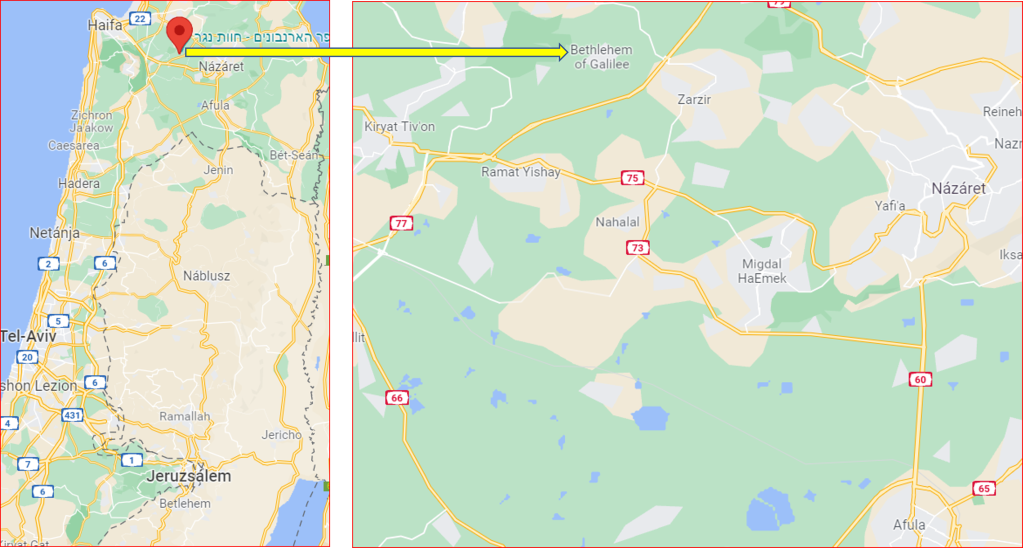
Even it is not proven whether “Jesus of Nazareth” was born in Judea, in Betlehem (without th) near Jerusalem, or in Galilee, in the other Bethlehem (with th) that still exists today, next to Nazareth? Have a look at Google maps below:
According to some archaeologists, the area around Betlehem near Jerusalem (which was still inhabited at the time of the ancient Kingdom of Judah) was partially deserted and desolate during the Roman occupation. In contrast, the area around Bethlehem near Nazareth was fertile and densely populated long before and at the time of Jesus’ birth and still is today.
Presumably, the legends surrounding Jesus’ birth are (like legends in general) based on facts. In my observation, legends crystallise after several versions have been woven around keywords (such as the number 3); nevertheless, the true origin is usually obscured.
Legends, in themselves, cannot be the basis of historical evidence. On the other hand, they can contribute to proving if the base of the legends can be identified.
According to the legends, Jesus was the expected Messiah for the “Three Kings”, the “Wise Men from the Sunrise”, or others, “Magi” from the East. However, it is legitimate to ask why then is so little recorded about Jesus’ youth, his studies, his travels, and his life until he began teaching at the age of 30? It is reasonable to think that when Jesus became a famous healer, teacher, and prophet, his followers added miraculous stories (e.g., virgin birth) to his approximate date of birth, as happened with other great prophets who founded religions.
The early Christians originally celebrated the birthday of Jesus on 6 January, the “day of the three kings”, or, according to another interpretation, the day of Jesus’ baptism in the Jordan (Epiphany). It was only in the early 4th century that the Church decided to celebrate the feast on 25 December, now Christmas Day.
It is generally believed today that this was the early Christian Church’s way of “covering up” the feast of lights of the faith of Mithras and the later Roman Sol Invictus (Invincible Sun). So luring the followers of the earlier religions to the newer Christian religion.
It is known that 25 December was initially the birthday of the Persian sun-god, Mithra.
According to recent research, Jesus was not born in AD1, but 7 years earlier, in 7BC. (7BC corresponds to “AD-6”, which in astronomy is simply -6; since there is no “zero” year in the AD system. The number zero was unknown in antiquity. The distance of the BC years from the AD years is obtained by the simple addition of the years with negative signs for the BC years, e.g. AD1-7BC = 1-(-6) = 1+6=7)
The year of Jesus’ birth, 7BC, was determined by the Hungarian Jesuit priest and astronomer Ágoston Teres (Gustav Teres), who died in 2007. Aurel Thewrewk Ponori, a well-known Hungarian astronomer, also came to this conclusion simultaneously.The Vatican tacitly accepted this scientific amendment.
In fact, we cannot be sure even nowadays
what year and what day Jesus was born, as I am going to show later.
Exiguus performed the calculation back to AD1 precisely 7 years earlier (AD525 instead of AD 532) than it would have been necessary for practice, even though the count could be done at most in a few weeks. And he made 7 years of error.
The double difference of 7 years seems to be a “strange coincidence”, of which we will come back later!
More significant than the legend of Jesus’ birth are the circumstances of Jesus’ crucifixion and resurrection.
The most sacred feast in Christianity is the celebration of the Resurrection, Easter.
(You can also watch Zeffirelli’s film on youtube.)
There are many ancient writings about the crucifixion of Jesus. Of the more than 200 ancient writings, only four were highlighted by the early Christian Church: The Gospels of Matthew, John, Mark, and Luke were accepted and canonised as a divine revelation; the others were considered apocryphal, forbidden.
Matthew and John were among the 12 apostles who heard the teachings of Jesus in the original. Mark was younger, recording the memories and opinions of the apostle Peter. Luke was Paul’s helper, companion, and disciple. Paul was not one of the 12 apostles and initially persecuted Jesus’ disciples as a believing Jew. It was only after Jesus’ resurrection, after their meeting on the “Damascus road”, that St Paul (earlier called Saul) was converted.
Whereas in St. Peter’s conception, Christianity was aimed at reforming the Jewish religion, Paul was the “chief ideologue” and most effective missionary to spread the Christian faith among the non-Jews.
According to the Gospels, the crucifixion of Jesus took place during the reign of Pontius Pilate in Judea (AD26-AD36), on the 14th of the Jewish month of Nisan, on a Friday before Passover. (Passover is the Jewish Easter, Nisan 15-21; Nisan, see Explanations)
According to today’s accurate calendar converters, only in AD26, AD33, and AD36 do the date Nisan 14 fall on a Friday during this period. (Previously, it was calculated that Nisan 14 and Friday coincided in AD27, AD30, AD33, and AD36.)
Despite the many gospel accounts
of Jesus’ death on the cross and resurrection,
only this Nisan 14 Friday seems to be sure.
The year of the crucifixion is uncertain.
Today, AD33 is the most accepted year,
but many scholars prefer AD36, and
there are other opinions, too.
Alone because of these uncertainties around the dates of Jesus’ life, it is not to avoid that some people think of the possible mistakes of the AD time reckoning.
The posts in chapter 1. are only a recapitulation of what is known to most readers, so it aims to help all readers to join.
It is often, but erroneously, called a “calendar error” when it is thought about the mistake or confusion of the time reckoning. However, the calendar is not confused.
The Julian calendar, still in use today, and the widely used Gregorian calendar derived from it work correctly according to the original plans.
Only the year numbers assigned as calendar years to the historical events could be confused.
That is why it is essential to see that the calendar and the reckoning of time are close today but originally had little or nothing to do with each other.
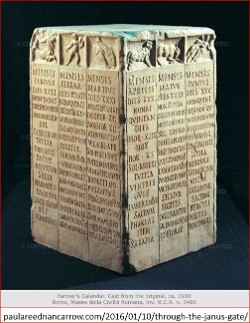
All calendars attempt to reflect the year’s structure in terms of astronomy, seasons, weather, related agricultural work, etc. However, the calendar did not have a year in the past because, in today’s sense, there was no year number, that is, no long-term serial number for the year!
The calendar could be carved in stone, as it remained valid for many years (until a possible calendar reform). An example of this is the initial, an image of an old “peasant calendar” carved in marble.
The calendar years we use today for antiquity are only the results of subsequent historical back-calculations. Some other time-calculations still alive today go back with their time reckoning even longer, 4-6 thousand years and their old years are the results of historically not too old retro-calculations.
However, because astronomical years differ, the old calendars can still help determine historical year distances to build up the correct chronology. Thus, we can retroactively assign a year number to historical events. For this purpose, I will start my analysis later with the astronomical dates of Julius Caesar’s calendar reform.
It is common knowledge that in our present AD calendar, we think about the past and the future in terms of the birth year of Jesus Christ, AD1.
The serial number of years goes back to the ancient, fixed year AD1, so the year numbers encompass a very long period of years for the past and the future.
For us, past or future years and periods are well illustrated by the calendar years because everyone can subtract and add. Today, the calendar and the reckoning of time are closely related.
The ancient Roman (except for a few scholars) thought about time in terms of a short period elapsed since a near and crucial historical event. For example, he talked about the years since the first year of an emperor’s reign, the year of office of a particular consul, or the fractions of a 15-year indiction cycle (see later). Thus, the starting point (the reference year) of the current ad hoc era changed rapidly.
As a post-summary, it should be noted that the serial number of years was not recorded earlier because the long-term year numbering in the modern sense did not exist. As a result, time reckoning was and is based on retro-calculations.Therefore, the year numbers (today’s calendar years) could be easily miscalculated, manipulated, or falsified and are uncertain.
It is now accepted that Jesus Christ was not born in AD1, as assumed for many centuries, but 7 years earlier, in 7BC (in astronomy, 7BC is marked as -6)!
Venerable Bede (Saint Bedae Venerabilis; AD673 – AD735), the English Benedictine monk and scholar known and esteemed to this day, lived and worked in the joint monasteries of St. Peter and St. Paul in the nearby parishes of Jarrow and Monkwearmouth (Northumbria, England). Bede was a versatile scientist, theologian, teacher of poetry and grammar, analyst and translator of ancient Greek and Latin ecclesiastical texts, and church historian.
Even as a young scholar, Bede was concerned with the calculation of Easter dates(Latin: computus paschalis or short computus) and the related analysis of elapsed time (time reckoning) in his work “On Time“. (Original Latin: “De Temporibus“, AD703).
These topics were later treated in detail in his “The Reckoning of Time”; “De Temporum Ratione”; most likely completed in AD725. We call AD725 “Bede’s year”.
In the latter work, Bede refers to a calculation made by the Roman monk Dionysius Exiguus in AD525. We call AD525 “Exiguus’ year”.
To create his Easter table, Exiguus calculated how many years had elapsed since the birth of Jesus Christ. (We will return to Exiguus and the Easter tables).
Exiguus introduced the expression of “Anno Domini”, although the title Dominus (Lord) had been applied to Jesus before.
As reconstructed later by experts, Exiguus found that the year of Jesus’ birth, AD1, corresponds to AUC754, the year calculated since Rome’s founding, and the year of the 195th ancient Greek Olympic Games too. (AUC; see Abbreviations)
Bede initially applied Exiguus’ findings only in compiling his own Easter tables.
In “De Temporum Ratione” and later in his “Historia ecclesiastica gentis Anglorum” (“Ecclesiastical History of the English People“; AD731), Bede dated some historical events relative to the year AD1.
Bede thus used the abbreviation AD and the term Anno Domini in his chronology with the deliberate intention to mark the time reckoning from the year of Jesus’ birth.
It was a new idea in the Christian Era
to calculate the years retrospectively
for such a long time, and at the same time
to show the forthcoming years prospectively, too.
Although, then it took about three centuries for the AD system to become widespread in Europe.
Based on Bede’s works mentioned above, the Roman Christian Church has made AD1 the starting year of our time reckoning, chronology, and calendar for about 1300 years.
Later, this position was also accepted by historians and the states of Europe, and it is used today worldwide.
I mention only very “quietly” that some professional historians and calendar experts (who know more about it than I do) disagree with the scientifically accepted year of ancient historical events. But understandably, they don’t say that. So, the “possible falsehood” of the AD time reckoning is mainly the subject of investigations by some “amateur researchers”. Three of them will be briefly presented below.
According to the different theories, falsehood in the AD time can happen in different ways:
by intentional falsification, or
by an error that was later recognised but concealed, or
by a misinterpretation, and the mistake was not identified earlier.
I have been interested in history, chronology, and ancient calendars for a long time, so I was astonished by the claims of amateur researchers and investigated three theories in detail.
I was intrigued by some of the plausible claims of the three best-known “calendar faking” theories but found all three approaches unacceptable and rejected them.
At the same time, I did not find the refutations of these three theories completely convincing.
To clear up my uncertainties, I had the only opportunity to work out my own (initially playful and self-serving) refutation of the three time-faking theories.
I found a historical contradiction in the late antiquity supported by an old Coptic legend. I call this contradiction “TheCoptic Paradox“. (See later.)
The Coptic Paradox, as a conjecture, has helped to refute the three theories.But to my great dismay, my refutation became a reinterpretation of the AD system, a new, shocking hypothesis.As far as I know, the creation of new hypotheses is usually preceded by a conjecture, a preconception of the author. In my case, it was the other way round. I wanted to prove that the calendar could not be falsified. The result is that the error of our AD time reckoning cannot be ruled out.
In my opinion and my new hypothesis, it is possible that our AD era is incorrect.The history of the AD era may contain 220 inserted years.
This inserted period can mean two things: on the one hand, unreal, untrue, fictitious historical events which never took place, and on the other hand, sequences of events that did take place but were described as extended or doubled in time.
At first, I believed my hypothesis was false since it did not meet the essential astronomical criteria, the counterarguments, used to disprove earlier theories.
At the same time, I suspected that the astronomical refutations of the three theories, which appeared to be accurate, might also be inaccurate.
I have briefly explained the essence of my hypothesis to the astronomer Albert Gesztesi. In astronomical terms, Albert considered it possible that the AD time had been miscalculated or falsified even by centuries! He called my attention to the Stellarium sky simulator program, an excellent software tool for astronomical analysis. I took this as encouragement, and I thank Albert again very much. After this background, I started to “learn a little astronomy”.
Astronomy showed the same results as my original thought process based on a historical paradox and legend.
In the following, I illustrate and confirm my new hypothesis mainly with this astronomical train of thought and calculations by analysing data of some selected historical events:
I approached some astronomical facts with an “unusual perspective”. I found that precisely 220 fictitious historical years can be inserted into the time calculation “in an astronomically difficult to realise way” (see later).
Since my doubts nevertheless remained, I recalculated the dates of some ancient historical and evangelical events. An astronomical comparison of the recalculated, new dates with the currently accepted historical dates showed that my hypothesis deserves further investigation.
My new hypothesis results, so to speak, in an “automatic solution” to the well-known calendar issue, the “Gregory’s dilemma”. (See Explanations)

















 The RECOUNTING of TIME