I know that it is inappropriate and ungrateful to engage in a polemic, or more “precisely” a “ptolemic”, with a “great old” scholar, but I must argue with Master Ptolemy! In my defence: Had Ptolemy not outed himself as the pope of the geocentric worldview, Giordano Bruno, who was at odds with him many centuries later, would not have been burned….
(You can be at odds with me; I’m just old and not a natural scientist. I can be persuaded because the debate is sweet, even if it is fiery for me. Of course, my argument is much less important than the debate of Giordano Bruno because I am not so convinced of my hypothesis as he was of his principles).
That’s all I said to the great old man:
“Dear Master Claudius!
I doubt you “accidentally” had overlooked the fact that there is such a significant discrepancy between your “own” precession parameters and Hipparchus’s. I do not believe you were not familiar with the differences in Spica coordinates measured in centuries.”
At first glance, this may sound like praise, but it is a serious objection.
Because of this “debate”, I researched the net and quickly came across some former “debaters” of late.
Many scholars have expressed doubts regarding Ptolemy’s data, especially regarding the data related to precession.
Some are more lenient. According to them, the multiple translations and copying, the slight differences in the Arabic numerals in the manuscript, which are easily confused, lead to distortions of content and highly disputable data in the Almagest, incredibly incorrect star coordinates.
The more hard-line scholars consider the Almagest unprofessional, misleading treatise, a collection of errors and forgeries, thus proclaiming Ptolemy himself a “forger”.
It cannot be entirely without foundation that in his book “Crime of Claudius Ptolemy”, Robert R. Newton called Ptolemy simple a “criminal”.
And Dennis Rawlins called Ptolemy “the greatest forger of antiquity”. He gave the Almagest the nickname “ALMAJEST” in a witty play on words.
“In the material that has survived, Hipparchus does not use a single consistent coordinate system to denote stellar positions. He inconsistently uses several different coordinate systems, including an equatorial coordinate system (i.e., declinations) and an ecliptic coordinate system (i.e., latitudes and longitudes).”
“…Dennis Rawlins recognised that “the locations specified by Ptolemy might be right ascensions… that the passage in Almagest 7.3 might be originally from Hipparchus”.
The summary of “PTOLEMIC”:According to renowned scientists who have detailed examined the subject,it cannot be ruled out thatsome of Ptolemy’s stellar coordinates included in Almagestare not celestial eclipticbut rather celestial equatorial, RA coordinates.
(Celestial ecliptic: ecliptic longitude (Ecl. long.) and ecliptic latitude Ecl. lat.); others zodiacal. Celestial equatorial: hour angle, aka right ascension (RA) and declination (dec.), the celestial equivalent of the Earth’s meridian system, Earth’s longitude, and latitude; blogger’s note. See below).
The most suitable stars for measuring the coordinates of the precession of the AEQ/VEQ points are those that are visible near the Ecliptic.
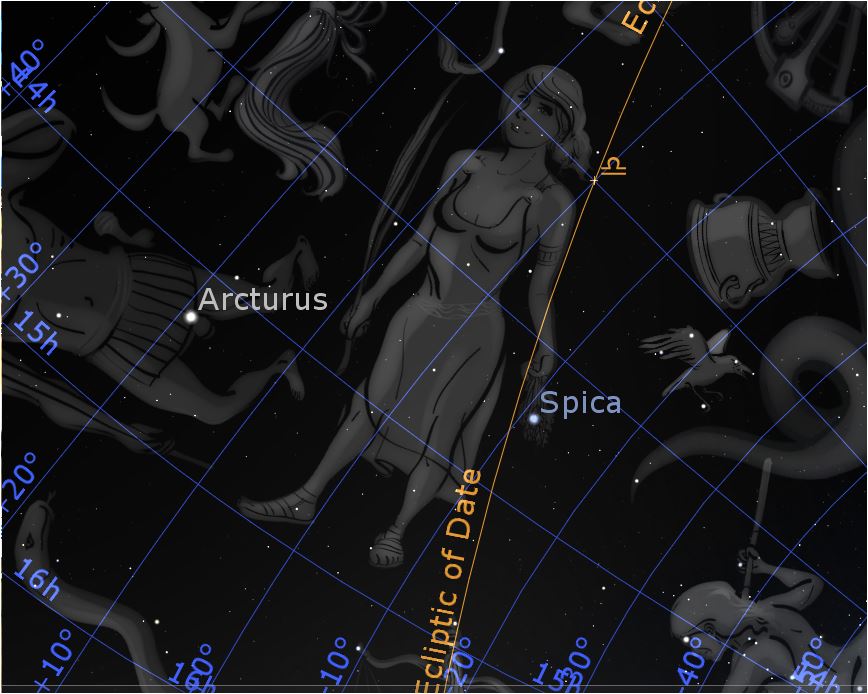
Spica is next to the Ecliptic, in the constellation of Virgo.
(In the middle of the goblet held in the left hand of the virgin sign, as shown in the photo above.)
Spica is easy to observe today on AEQ days because it appeared above the horizon when the Sun dipped below, and the sky darkened. This was not the case in ancient times. It is known that the coordinates of Spica in antiquity were measured primarily indirectly through the coordinates of the moon. The reason for this is as follows:
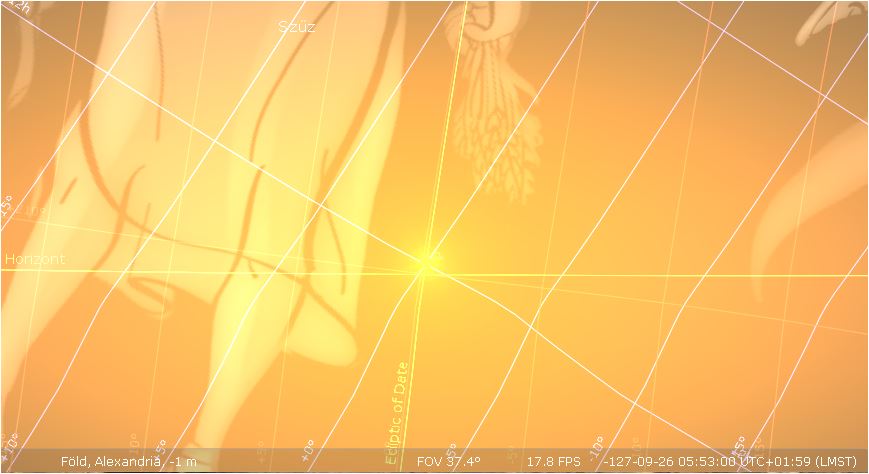
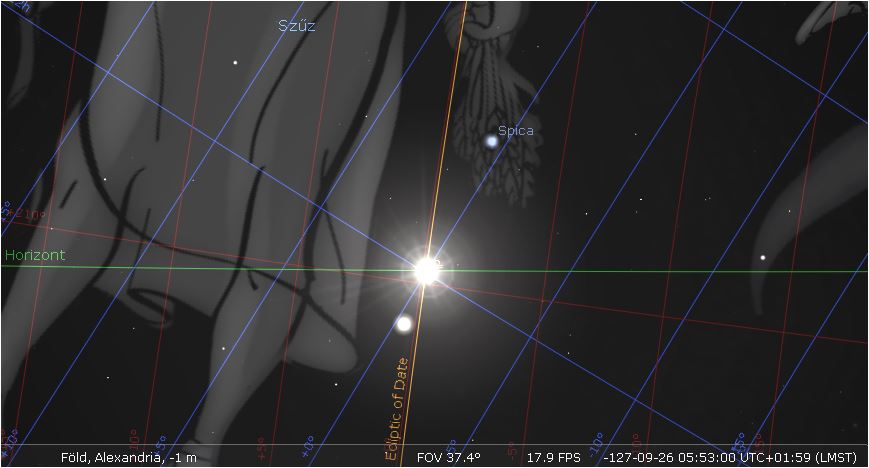
In the centuries of Timocharis, Hipparchus and Ptolemy, the celestial point of the autumn equinox, the AEQ point, was virtually very close to Spica. Today, the AEQ point is further away from Spica, as the photo above shows. Around the AEQ day, the Sun is also close to the AEQ point in the sky. This means that Spica also appears close to the Sun around the date of the AEQ. Therefore, in the centuries above, around the AEQ day, Spica was not visible to the naked eye because the Sun blinded the observer, as shown in the figure below.
Spica went under the horizon just before sunset and rose above the horizon just before sunrise. The following photo is darkened to show Spica just above the green line of the horizon and the Sun just on the horizon. (Of course, you can’t look below the horizon, only Stellarium allows you to do that.)
Both photos above were shot by the blogger with Stellarium at Sunrise on AEQ day of 128BC, in Alexandria, Egypt.
Fortunately, the full moon is just opposite the Sun. So, the coordinates of the Sun can be determined easily by measuring the coordinates of the moon.This was a usual procedure in antique astronomy.
Consequently, the simultaneity of the AEQ day and the full moon day could play an essential role in measuring the celestial position of the Spica. Note: Of course, the relative coordinates of Spica and the other stationary observable stars near the ecliptic plane (Alpha LEO; Alpha CMi, etc.) also supported the determination of the coordinates of Spica.
Let us look at the years of measurement from this point of view.
It can be observed that in two of the measurement years mentioned (278BC (-279); 128BC (-127)), AEQ and the full moon coincided.But the currently hypothetical year AD138 was not such anAEQ & full moon year.
It looks likely that all three years of measurement had to be coincident AEQ & full moon years.
However, instead of the uncertain AD138,
the year AD131 would have been more appropriate,
as this is the closest AEQ & full moon year.
AD150 could also fit but is out of the question because it is already the year of publication of Ptolemy’s very long and earlier written work.
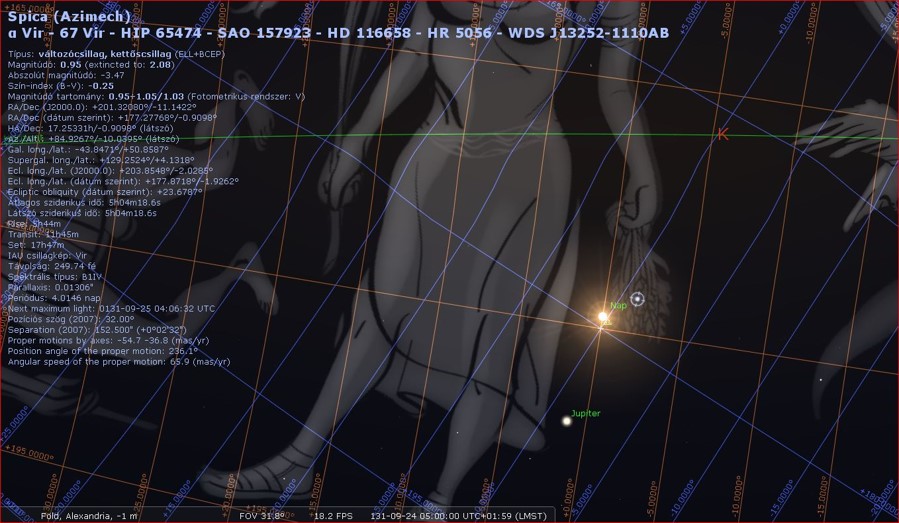
The photo below was taken on 24 September AD131, on the day of the AEQ, about 1 hour before sunrise, and shows the sky from Alexandria. The Sun is still below the horizon, marked by the horizontal green line, near the AEQ point, the intersection of the Ecliptic and the celestial equator. Spica is to see in the circular frame next to both the AEQ point and the Sun. The coordinates of Spica are shown in the list on the left of the photo. It can also be seen that Spica is just above the Sun, and it will rise slightly before the Sun but will not be directly observable due to the Sun’s blinding proximity. (Stellarium photo by the blogger.)
The following photo is a wide-angle view of the East-West sky on AD131 on 24 September, on the day of AEQ, at the same time as the photo above. The full moon is well visible above the horizon, near the symbol for the VEQ celestial point, the other intersection of the Ecliptic and the celestial equator. The full moon is positioned opposite the Sun but will soon dip below the horizon. The coordinates of Spica can be calculated indirectly from the coordinates of the full moon. (Stellarium photo by the author.)
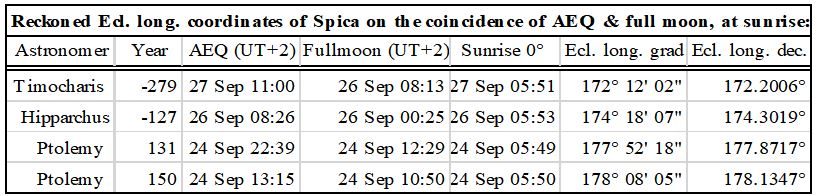
Let us have a look at the Ecl. long. coordinates of Spica on the dates of measurings as we see it, on the possible dates of AEQ and full Moon coincidence:
Table 4.
The above Table 4. is based on the data of Stellarium. It shows the changing of the ecliptical longitudinal (Ecl. long.) coordinates of Spica. The ecliptical longitudinal coordinates are traditionally measured from the VEQ point’s longitude zero. That is why the coordinates of Spica (and not those of the AEQ point) are changing.
Table 4. tells us, too, that the Ecl. long. of Spica gradually “approached” the AEQ point, which is at 180° Ecl. long. This table plays an essential role in the following.
There are several ways to calculate the attributes (parameters) of precession from the astronomical data of Almagest.
This subsection seems to be a short digression, but I recommend reading it not because it is short but because it is relevant for what follows.
Hipparchus measured the length of the tropical year (solar year) as 365 1/4 days – 1/300 days or expressed others 365 days 5 hours 55 minutes (rounded, slightly shorter than the well-known 365 1/4 days).
Today’s figure for the tropical year is ~365.24219 days, i.e., 365 days, five h 48 m 45s.
He measured the length of the sidereal year, 365 1/4 days + 1/144 days, i.e., 365 days 6 hours 10 minutes.
Today’s figure for the sidereal year is longer than the tropical year by 20 min 24.5 s, ~365.256360 days, i.e., 365 days 6 hours 9 m 9,54s.
The parameters of the precession can be calculated from these data.
The 15-minute per year time difference between the tropical and sidereal years lengths corresponds to 1 day in 96 years (24/0,25=96), and the cycle time is 96*365.25 = 35,064 years.
It means round 1°/97.4 years (96*365,25/360= 97.4) angular velocity. Both parameters are very much imprecise. Namely, according to today’s measurements, the difference between the length of the tropical and sidereal years is not about 15 minutes but about 20 minutes. The 20 minutes results in a rounded 72 years per degree instead of 97.4, making the cycle time of 25.920 years mentioned above. 72*360=25.920.)
However, astronomers say that we cannot be sure that Hipparchus was aware of the possibility of calculating the cycle time from tropical and sidereal years.
Based on the fixed star coordinates of Hipparchus and Ptolemy, the parameters of precession are calculated as follows:
Hipparchus’ measuring comes from 128BC (-127), and Ptolemy’s probably from 138AD.
According to Almagest, in the 265 years between these two measurements, the ecliptic longitudinal (short Ecl. long.) angular rotation of the fixed star SPICA was 2°40′ = 2.67°. Therefore 265/2.67 = 99.25 years/degree.
Calculated in this way, the angular velocity of precession is 1°/99.25 years, and the cycle time is 35,730 years (99.25*360=35,730).
Based on this latter calculation, the literature states that according to Ptolemy and the Almagest, the angular velocity of precession is at least 1°/100 years, with a cycle timemaximum of 36.000 years.
This, like the above calculation, is a wildly inaccurate figure, too.
According to today's measurements: angular velocity: 1°/71.6 years, cycle time: 25,776 years. The ancient error is around 38%.However, it is also written in Almagest and generally accepted that 152 years elapsed between the measurements of Hipparchus and Timocharis and that Hipparchus determined an angular change of 2° Ecl. long. over this 152 years. A 2° precession angular change over 152 years corresponds to a precession angular velocity of 1°/76 years and a cycle time of 27,360 years. This is a much more accurate result than that of Ptolemy. It is also close to today's values given above.Despite this facts, the literature emphasises Ptolemy's cycle time of "up to 36,000 years" and generally ignores Hipparchus' much earlier and more accurate figure of 27,360years! For me, it's very noticeable and disturbing that there is such amassive difference between the calculationsbased on the coordinates of Hipparchus and that of Ptolemy.This observation will soon become very important!
Claudius Ptolemy was a Greek staff member of the “Great Library of Alexandria” (Musaeum or Mouseion), the knowledge centre of antiquity. Ptolemy was neither an innovator, researcher, or practical scientist but rather a “systematic mind”, an “integrator”.
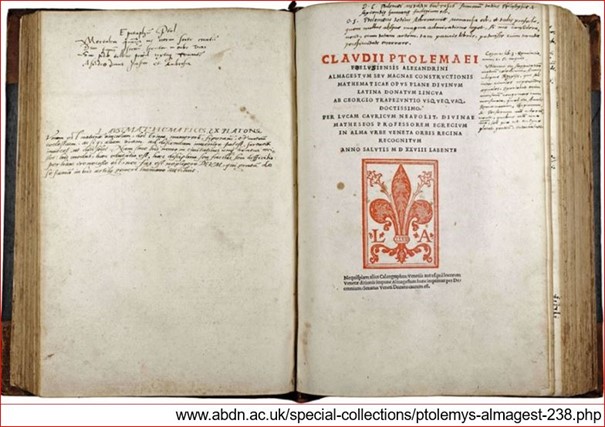
As a diligent reader and scholar of the scientific achievements of his time, he collected and integrated the accepted teachings of mathematics and astronomy in his magnum opus, “Syntaxis Mathematica“. The “Magna Syntaxis” was later called “Almagest” from the Arabic word for “greatest”.
Hipparchus’ ideas and calculation data on precession are known from Ptolemy’s Almagest, which the author completed around 150 AD, as we know it today.
Unfortunately, Hipparchus’ works have been lost. (Except the so-called “Phaenomena” commentaries).
Furthermore, “the source of the source”, Almagest, has been lost, too.
Ptolemy’s work was written in Egyptian Greek and first only translated into Latin in the 12th century on the basis of an earlier Arabic translation. Earlier fragments of ancient Greek copies also surfaced in the 15th century.
The Almagest had defined astronomers’ “geocentric world view” for over a thousand years. Unfortunately, it has displaced and almost forced into oblivion all other ideas such as the “heliocentric theory”, previously known in Mesopotamia.
It is particularly noteworthy that despite the absence of the original work, Almagest’s astronomical claims were for many centuries regarded by the Roman Church and scholars alike as indisputable astronomical truth. Despite (or perhaps because of?) Almagest (following Hipparchus’ worldview) held to the geocentric theory; it became a long-living paradigm of astronomy.
An essential “annexe” of the Almagest is the so-called “star catalogue“, which gives the celestial positions of hundreds of stars in tabular form based on data from Hipparchus. (Almagest’s “Star Catalogue”: coordinates of 1022 stars, the vast majority of which are derived from Hipparchus, as we know it today.)
Of course, from the voluminous Almagest, we highlight and examine only the issues of interest to us.
The change in stellar coordinates relative to AEQ and VEQ due to precession is most apparent and measurable in the case of fixed stars along the ecliptic (e.g. SPICA, REGULUS).In antiquity, due to the slow rate of precession change, this observation could only be made by comparing the data from old and new measurements repeated centuries later. Hipparchus also compared his own data with the old data of his predecessors. And Ptolemy compared the measured data of his own time with those of Hipparchus.
Ptolemy did not mention any historically identifiable date for Hipparchus’ years of life (190BC-120BC), these years being derived from a posterior astronomical countdown.
It is now reckoned that Hipparchus compared the data of his astronomer predecessor Timocharis and of earlier astronomers in New Babylonia (Chaldee, registered around 280BC) with his own data (measured around 128BC).
It is also assumed that the astronomical data of Ptolemy’s own time were taken from measurements made in or around AD138. Probably, they were not Ptolemy’s own measurements but the somewhat earlier results of a more practical contemporary.
The precession objection is the most compelling of the above astronomical refutations to the possibility of a historical time insertion. So I will devote some posts to its examination.
The objection is essential, so I will repeat it:
“If history were about 2.5 centuries shorter, there would have been about 3 degrees less angular rotation because the angular velocity of precession is constant to an excellent approximation. Three degrees would be too much of an error even for old historical measurements, ”
As told, it is almost a paradox!
Namely, we must assume that only the years of the Roman era are shifted back in time, while the AD years of Hipparchus’ lifetime should be considered correct. In other words, we should find an astronomical solution to solve this contradictory situation.
Familiarity with some elements of astronomy is essential in this part, so I am serving the description in several smaller “portions” in the hope that it will be more “digestible”.
First, I will briefly explain the essence of precession because, in my experience, relatively few people are well informed on the subject.
Since ancient times, astronomers have been able to determine the time and celestial position of Vernal Equinox (VEQ) and Autumnal Equinox (AEQ), the astronomical date and celestial points in the sky with sufficient accuracy.
The VEQ and AEQ points are the intersections of two well-known “virtual orbital curves”. They are the intersection points of the Sun’s elliptic orbit (as seen from the Earth in the ecliptic plane) and the celestial equator (the projection of the Earth’s equator onto the sky in the Earth’s equatorial plane).
Ancient astronomers considered these points of intersection, which are almost opposite each other in the sky, as fixed. They usually determined the position of planets, stars and constellations, the celestial coordinates of the latter, relative to the AEQ or VEQ point.
Hipparchus (Greek: Hipparchcos; BC190-BC120), the great ancient Greek mathematician-geographer-astronomer, is credited with the first description of the astronomical fact that the position of AEQ and VEQ in the sky relative to the fixed stars is not constant. According to many researchers, this phenomenon had been known before, for example, in Babylonia, but was generally neglected.
Hipparchus recognised that (according to the geocentric model) it is not only the Sun and the stars that orbit the Earth. For the observer on Earth, the celestial coordinates of the VEQ and AEQ points change relative to the virtually stable position of the fixed stars.
Both points wander around the ecliptic over a very long period, roughly 25.920 years. It is a motion alongside the constellations observable near the ecliptic plane but in the opposite direction to the celestial motion of the Sun. (The round 25.920 years cycle time is usually used, but the calculations and measurements differ slightly from this rounded value)
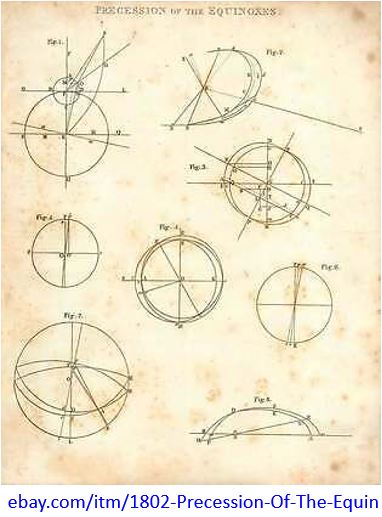
This phenomenon is called the precession of equinoxes, short precession.
Precession is the third form of Earth’s movement, besides the rotation of the Earth around its own axis and its orbit around the Sun.
We can say that the Earth’s axis, seen from the north but from a very great distance, rotates (like the axis of a spinning top) from east to west around the north pole of the ecliptic in about 25.920 years. During this time, the Earth’s axis of rotation slowly aligns with different stars. Currently, we see the North Pole Star (Polaris) near the extension of the Earth’s axis of rotation. This was not the case in the past and will not be the case in the distant future. So, in about 13 000 years, Earth’s axis of rotation will be aligned with the brightest star in the constellation Lyra, the fixed star Vega.
The phenomenon of precession is also one of the foundations of astrology, as the zodiac signs are the “wandering constellations” visible close to the ecliptic plane. The average time between adjacent zodiacal constellations is 25.920/12 = 2.160 years. The boundaries of the signs are not clearly defined. These years we are moving from the constellation of Pisces to Aquarius.
The above diagram clearly shows the ancient symbol of VEQ, ♈︎. In celestial coordinate systems, the VEQ point has been used as a reference point for a very long time, for as long ago as the VEQ point yet coincided with the starting point of the constellation Aries. In fact, the symbol ♈︎ is a simplified drawing of the “horns of Aries”. And, as I see, it resembles a renewal, an unfolding flower, a branching shoot, too. Because of a similar reason, the symbol of the AEQ point, opposite to the VEQ point resembles a balance ( Ω, underlined Greek omega) and symbolizes the constellation Libra. Both ancient symbols reveal the symmetry of duality.
On both, the VEQ day and the AEQ day of the year, the 24-hour solar day is divided into two equal parts, a 12-hour light day and a 12-hour dark night.
The Sun symbolises a powerful male deity who illuminates our day and forces upon us the darkness of night feared in ancient times. The Sun is difficult to look at in the “eye” because it blinds.
The Moon represents a gentle goddess who dimly illuminates the darkness of night, and we can look into her eyes without fear.
Although the Sun is the more significant life-giving celestial body, the Moon is the more exciting, the more attractive celestial phenomenon, “who” is constantly changing her “appearance”, changing her dress, like a lady. This is how the ancient observer saw it, and we can agree with him today.
I started this chapter with this mood picture because some (probably “boring” for most of you readers) calculations will follow soon.
The Metonic cycle is almost exactly 19 years, after which a given moon phase recurs within the astronomical year. (Relative to the day of a given astronomical phenomenon like the VEQ). The lunar month and the moon phases have initially been more significant in time representation and measurement than the solar year.
It is evident that observations of the “behaviours” of the Moon formed the basis of the early “lunar calendars”.
The ancient Chinese also knew the Metonic cycle. Thus, in the traditional antique lunisolar calendar, the Chinese still calculate the changing date of the Lunar New Year (Spring Festival) mainly based on the phases of the Moon.
The existence of the 19-year Metonic cycle was already known to the Babylonians and was used to correct the length of their lunar calendar year. However, the cycle was named after Meton, an Athenian mathematician and astronomer who lived in the 5th century BC.
The Metonic cycle allows for the construction of a calendar in which 12 years consist of 12 lunar months and seven years consist of 13 lunar months so that the total of 19 years spans 6940 days.
Callipus later specified the length of the Metonic cycle to 6939.75 days.
Both the 6.940 days and the 6.939,25 days were applied in different ancient Greek lunar calendars to correct the length of the year.
We have also seen that the calculation of the Easter tables (computus) in the Julian calendar was also based on the Metonic cycle.
The falsehood of the time reckoning can only be astronomical, so astronomy had to be relied upon to confuse the AD time. Even in ancient times, astronomers knew very well that any calendar, as we would say today, is only a tool for earthly digital approximation and modelling of analogue celestial reality.
Throughout the ages, people have tried to adapt the calendar to the periodic movements of the celestial bodies, first and foremost the Moon.
For this reason, ancient astronomers did not work with the calendar but with the well-observed tropical years (solar year) and the synodic lunar months (the time between two successive, similar lunar phases).
However, as seen, the 220 years of insertion is not an integer multiple of the 19 years of the Metonic cycle. Nevertheless, we should examine what happens to a given lunar phase assuming of insertion of 220 years! *The length of the tropical year as measured today: 365.24218967 days. * The synodic lunar month as measured today: 29.53058872 days.
(The measured values vary slightly with time.)
The Metonic cycle compares 19 tropical years with the length of 235 synodic lunar months. This interval was transparent and relatively easy to measure in ancient times. Of course, the data differed slightly from current values; we know this, for example, from the precise dates of the old Chinese Taichu calendar.
Based on the above data, the 19 tropical years today correspond to 6939.60160393 days. The duration of the 235 synodic lunar periods is 6939.68834920 days.
Compared to the 19 tropical years, the Lunar phase delay today: is 0.08674547 days. (2h 5′) So, the Metonic cycle is a little inaccurate!
This inaccuracy makes 1.004421232 days, based on 220 years offset.
Very accurately, one day lunar phase time difference,
in the case of 220-year time offset
forwards or backwards.
An astronomical time difference,
comparing a specific event in the astronomical year,
such as VEQ.
In the case of a forward jump (omission) of 220 years, it means a delay of the lunar phase by one day.
In the case of a backward jump (insertion) of 220 years, it means an advance of the lunar phase by one day.
As mentioned above, the timing of the phases of the Moon cannot be determined precisely with the naked eye.
Furthermore, the timing of celestial events, on average, slowly recedes in the Julian calendar and additionally “jumps back and forth” due to leap years.
The above three inaccuracies are superposed, added together, or subtracted.
In the case of a 220-year shifting backwards in the Julian calendar, a given lunar phase is on average 1.7 days ahead. Two hundred twenty years earlier, a given new moon occurs on a later but slightly different date from the average delay in the Julian calendar. We have already seen, for example, that the first new Moon of 45BC occurred almost quite exactly two calendar days later than the first new Moon of AD176.
To sum up:
The above slight inaccuracy of the Metonic cycle
explicitly supports the hiding of the insertion of 220 years.
If 220 years were inserted, all historically recorded
lunar phases would have been transformed
into a similar lunar phases 220 years earlier.
But the lunar phases remained almost precisely
on their original astronomical day,
so it wasn’t easy to detect the insertion!
It was especially challenging to recognise the insertion
because of the inaccuracy of the calendars.
To sum up: The above slight inaccuracy of the Metonic cycle explicitly supports the hiding of the insertion of 220 years. If 220 years were inserted, all historically recorded lunar phases would have been transformed into 220 years earlier similar lunar phases. But the lunar phases remained almost precisely on their original astronomical day, so it wasn’t easy to detect the insertion! It was challenging to recognise the insertion because of the inaccuracy of the calendars.
So, the slight inaccuracy in the Metonic cycle opened a ‘loophole’ to insert the 220 years in a way that is difficult to recognise.
In addition, at most, only a few astronomers could have wondered precisely on which calendar date a given lunar phase could have fallen 220 years earlier.
Nor have I found any reference in the literature to this particular property of the 220 years, that 220 years are associated with a moon phase shift of precisely one astronomical day.
Among the refutations of the theories about the falsehood of the AD time, I agree with the statement that the number of years to be inserted must be divisible by 4. Otherwise, the long-established rhythm of Julian’s leap years would be upset. Even the layman could have quickly realised this mistake.
However, the assertion that the number of years to be inserted must be divisible by 28 (the number of years in the solar cycle) is not acceptable, as far as I see.
My reason is that the 28-year solar cycle is only a feature of the Julian calendar.
The solar cycle is not fulfilled even for the Gregorian calendar, only a tiny variation of the Julian calendar!
If someone thinking according to the Julian calendar wants to insert 2-3 centuries, then, of course, to keep the order of the seven days of the week, he would have to consider the solar cycle. So that only annual intervals, which are divisible by 28, would come into question for insertion.
However, Friday 14 Nisan, (The Friday before the Jewish Passover, Pascha, the “Jewish Easter”) could not have been changed by the insertion. This date was engraved in the memory of believers as the date of Jesus’ crucifixion. Consequently: to keep Friday on the 14th of Nisan, ones should think and do according to the Jewish calendar.
The Jewish calendar is an old and essentially religious calendar. Its primary use is to calculate the dates of religious holidays, but it is also used sometimes in civil life, for example, to estimate agricultural dates. It is considerably more complicated than the Julian calendar because it is “lunisolar”, i.e., it can adapt to the course of the moon and the sun simultaneously over a long period. It achieves this by defining six years of different lengths (353, 354, 355, 383, 384 and 385 days). Although the subject is fascinating, only a single feature of the Jewish calendar is of interest to us now, so we will only deal with it in the following.
Therefore, the structure of the Jewish calendar differssignificantly from that of the Julian calendar.This means that other rules applyfor the possibility of insertion of a periodthan in the Julian calendar.
The periodicity of Nisan 14 Friday is not evident in such a complicated calendar. Examining the Jewish calendar shows that Nisan 14 Friday occurs mainly only 2 to 3 times in a decade.
We want to investigate whether it allows inserting precisely 220 years, so the situation is simple.
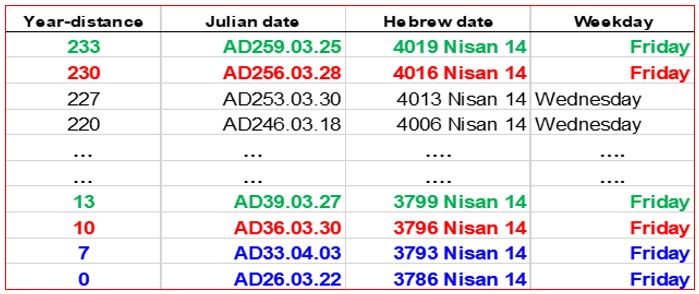
We need to think in perspective because we are looking for the original state in a later period. So, we “only” should determine whether, by shifting the years between AD26 and AD36 (the possible period of the date of Jesus’ crucifixion according to our current knowledge) to another period 220 years later, in what years the date Nisan 14 would fall on a Friday if any.
In the blue year-rows, the 14th of Nisan falls on a Friday, but they do not have a fitting pair of Fridays 220 years later. Therefore, the black year-rows are irrelevant because the 14th of Nisan does not fall on a Friday 220 years later.
The green and red lines are 220 years apart and form Friday pairs of the 14th Nisan.
According to today’s view, only AD33 or AD36 comes into question, so the green rows can be neglected.
The conclusion based on Table3 is:
In AD256, the backward shift of the date
Nisan 14 Friday by 220 years was possible
according to the Jewish calendar.
So, it was not necessary to follow
the 28-day rule of the Solar Cycle
to maintain the order of the
seven days of the week during the insertion.
The year of Jesus' crucifixion may have been
shifted back alongside the time scale by 220 years.
Note:
The Friday can remain on Nisan 14 at inserting of 200 years, too (a’ la Hunnivari). (Nisan 14 falls on a Friday in AD236).
From this, I conclude that the insertion of the 220 years of my hypothesis may have been attempted in two independent tranches of 20 and 200 years, probably at different times.
In contrast to the insignificant spring festival of Hilaria, one of the most important ancient pagan Roman festivals was Saturnalia.
Saturnalia was the festival of the god Saturn.
The feast began on December 17, already centuries before Caesar. Saturnalia was, at earlier times, the celebration of the end of agricultural work in late autumn.
People remembered the age of the creation of agriculture, the old “golden age” ruled in Roman mythology by the god Saturn. It was a work break and a folk amusement with music, dancing, eating, drinking, and gambling. Family members, friends and close acquaintances gave each other presents, just as we do at Christmas. People played a “reverse world”, a “role reversal”. The enslaved people became masters; the masters served their slaves, etc.
God Saturn was more than the “creator” of the “golden age”; he was also the god of time, the Roman equivalent of the Greek god Chronos. Chronos was the son of Uranus, and he was the leader of the Titans and the father of the Roman equivalent of the Greek Zeus, Jupiter.
In the days of Saturnalia, people also overcame their fear of the darkness of winter. They waited anxiously until the wheel of time had turned completely, the winter solstice, which brought them the sun’s rebirth.
Saturnalia fell some days before the winter solstice (WIS) and was associated with the traditional Roman sun cult. Saturnalia was gradually celebrated longer and longer, up to 7 days, until the day of WIS. In 45BC, the Date of WIS was 23. December, according to the new Julian Calendar.
The Romans had worshipped the sun god Apollo since the founding of the city of Rome. The “many-sided” Greek Apollo (son of Zeus) and the Etruscan Apulu served as models. They later created their own main sun god, Sol. The sun god Sol can be considered the “united” Roman equivalent of the sun gods of the conquered territories, the ancient Greek Helios, the eastern (originally Persian) Mithras and the Egyptian Re.
They built temples and celebrated in honour of their sun gods, but especially important was the Winter Solstice (WIS), the symbolic rebirth of the sun.
The cult of the sun was restored and strengthened by Emperor Augustus. Augustus was the “son of the sun” and regarded the sun as his symbol.
With the increasing importance of the sun, in AD274, Sol Invictus, the “invincible sun” festival, was set for December 25 (Mithras’ birthday). The Roman sun cult even survived the official toleration of Christianity for many decades (AD313, “Edict of Milan” by Constantine I; Constantine the Great).
People experienced the flaws of the old calendar, as the Date of Saturnalia moved away from the easily observable astronomical phenomenon, the winter solstice (WIS), and even from the winter itself.
It was crucial to bring Saturnalia back to its original position just a few days before the winter solstice.
Despite the drifts during the old, flawed calendars, people kept the dates of various old holidays, while those became independent of their original astronomical meaning. For this purpose, they could use the order and the distance in days of the various holidays.
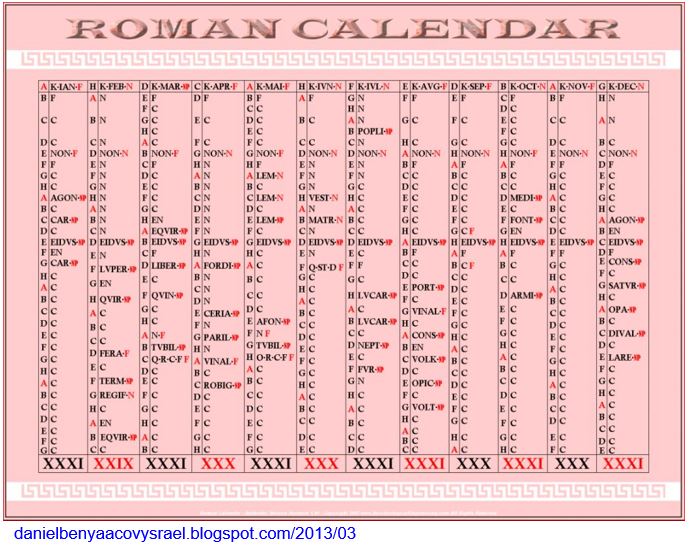
Let us compare the distance measured in days between the first day of Saturnalia and the Hilaria day of the following year in the old Roman and new Julian calendars, according to Table 1.
In the old calendar, 12 days (29-17) have passed from the day of Saturnalia to the end of December. Add to this the days in January (29), the days in February (28) and the days until March 25. In total: 12+29+28+25= 94 days in the old calendar.
In the new Julian calendar, December and January were 2 days longer than before. So, there are 14 days between December 17 and the end of December, and 31 days have passed in January instead of 29. With formula: 94-14-31-28 = 21.
Namely: 17 December + 94 days = 21. March in the new calendar.
The old March 25 (the unimportant Hilaria-VEQ) was automatically “pushed back” by 4 days to March 21 in the new calendar by adjusting and redefining the time relationship between Saturnalia and WIS. Therefore, the Date corresponding to March 25 in the republican calendar has automatically become 21. March in Caesar’s new calendar.
There are further indirect shreds of evidence that VEQ may have fallen on March 21 in the Julian calendar’s first year, but calendar researchers have ignored these. The First Council of Nicaea set the Date of the VEQ to calculate the Easter tables on March 21, and Pope Gregory XIII also set the VEQ date for March 21 in his Gregorian calendar (see later). Both determinations could have opted for a different day. So, I find it possible that both the bishops of Nicaea and Pope Gregory XIII knew that VEQ in the Julian calendar initially fell on March 21.
My point in the above arguments was to clarify that there was no reason to intentionally set the VEQ date to a specific date in the new calendar. The VEQ day of the Julian calendar was automatically moved from the old, and in Rome,that time unimportant date, March 25, to a new date, March 21. Caesar’s priority in the calendar reform was to restore the Saturnalia. However, this also put the WIS in its old and astronomically proper place. The reform provided an opportunity to place the first Kalendae of the new calendar on January 1, on a visible new moon day. Because of the Metonic cycle, this was only possible once every 19 years.
As Dictator of Rome and Pontifex Maximus, Julius Caesar obviously had some historical and political expectations concerning the new calendar.
Mainly for political reasons, he had to try to preserve the most important old Roman traditions (as we have seen regarding Kalendae) while introducing the new calendar. For example, according to recent studies, he retained the length of the 31-day months (Martius, Maius, Quintilis and October) and the 28-day February (in non-leap years). But he had to increase the previous 29 days of April, Ionius, September and November to 30 days and that of Ianuarius, Sextilis and December to 31 days.
Later, the month Quintilis was renamed Iulius (44BC) in honour of Caesar, and the Sextilis was renamed Augustus (8BC) to recognise Emperor Augustus.
The length of the months in our calendar has remained unchanged since then.
There were widespread speculations earlier that the intervention of Emperor Augustus set the length of today’s months.
Based on the idea of Sacrobosco (13th century), it used to be assumed that Augustus shortened February by one day. Only as the result of this shortening could it become the month of August 31 days long, as the extension of Sextilis by that day. This earlier view has recently been refuted, mainly based on the writings of Macrobius (5th century).
Today's most robust assumption is that Caesar,
referring to ancient Roman traditions,
would have set the vernal equinox (VEQ) date on March 25.
Other calendar experts report that the VEQ-day was moved to March 22., 23. or 24 in the new calendar. (See Hunnivari for details).
March 23. is obviously assumed to be the first VEQ-day in 45BC because we already know today (by astronomical recalculation) that the VEQ in 45BC took place on March 23.
I state that we only assume today that the VEQ date was essential to Caesar because it is crucial today. The VEQ date in Judeo-Christian culture is used (as we have already seen) to calculate the date for Passover and Easter.
This was not the case in ancient Rome! Anyhow, in the astronomy of ancient Rome, the date of VEQ played a minor role, such as the date of the autumnal equinox, short AEQ.
In my opinion, Caesar and his astronomers hardly took the VEQ date into account when they worked out the Julian calendar. There was no official state holiday associated with the vernal equinox in Rome, and only an insignificant traditional folk spring festival, “Hilaria”, felt around VEQ day. This “spring Hilaria” was celebrated on March 25, indeed. This date was commemorated sometime much earlier because, due to known calendar errors, VEQ could usually only fall on a day other than March 25. In addition, the word Hilaria means “feast of joy” and was therefore also used for other minor holidays.
This observation leads to fundamental implications in the next post.
It is advisable to take a “short detour” here to survey the structure and logic of the Roman months, which is very unusual for us. The Roman calendar (according to ancient traditions already long before Caesar’s time) recorded only three important reference days per month.
These reference days were the following: K (Kalendae, Calendae), NON (Nonae) and EID (Idus, Eidus).
In the old lunar calendars, Kalendae meant the day of the appearance of the new crescent moon visible to the naked eye, i.e., the first day of the new month, the day of the announcement of the month.
The day of Kalendae was “proclaimed” by the priests at the beginning of each month, announcing the length of the month and calling for the payment of debts etc. (the Latin word “calo” means to proclaim). The term calendar derives from his Latin word and is used in many languages (English Calendar, German Kalender, Old Hungarian Kalendárium, etc.).
In ancient times, even astronomers considered the already visible new moon crescent as the new moon, the day of Kalendae, instead of the invisible astronomical new moon about two days before. (The binoculars were not yet known).
Idus originally meant the middle of the month when the full moon fell.
The Nonae, introduced later, represented the ninth day, calculated “inclusive” and backwards from Idus. (8th day according to our present method of calculation), the day of the first crescent, and indeed the waxing crescent.
The days were generally (with few exceptions) identified by these reference days but counted backwards and inclusive. In fact, the days missing until the specified reference day were counted.
For example, the birthday of Emperor Augustus, September 23, is called the 9th day before the Kalendae of October (ante Diem IX Kalendae Octobres) in the 30-day month of September. (8th day before the Kalendae of October for the old 29-day month of September.)
Due to changes in the lunar calendar, the old astronomical significance of the reference days disappeared. Because of the extended length of months, there was only infrequently a new moon on the day of Kalendae.
Caesar, however, mainly from political considerations, retained the tradition of reference days in the calendar structure, especially the role of Kalendae but only as the starting day of the month.But still, according to sources, in the year the new calendar was introduced, January 1 was the first new moon day after the winter solstice of the previous year.
It sounds very logical because this way, the first Kalendae day of the new calendar of Caesar announced not only the first month of the new calendar but also the new calendar itself.
In my opinion, starting the new calendar with Kalendae on the new moon was particularly important. It symbolised that the traditional date reference days and calendar structures were appreciated and retained.
As we have seen, this calendar setting may have been achieved by adjusting the length of the previous “last confused year”. (As it is known today: 46BC, 445 days)
On the other side, today, we know from astronomical retro-calculations that there was no observable new moon in the Roman sky on January 1, 45BC. The barely visible, very narrow new moon crescent appeared in the Roman sky only on January 3 in 45BC.
This consideration alone is enough to question the acceptance of BC 45 as the realistic first year of the Julian calendar! Namely, the new moon crescent was only observable in 53BC, 34BC, 15BC, AD5, AD24, AD43, AD62 (etc., according to the 19-year Metonic cycle) on January 1 in Rome.















 The RECOUNTING of TIME